Skip to content
February 8, 2012 / damchoe

On the move

20120208-071759.jpg

February 8, 2012 / damchoe

New addition

February 6, 2012 / damchoe

Peace and Green

February 5, 2012 / damchoe

Bhutanese bowl

February 3, 2012 / damchoe

Study, practice, and my eighth year.

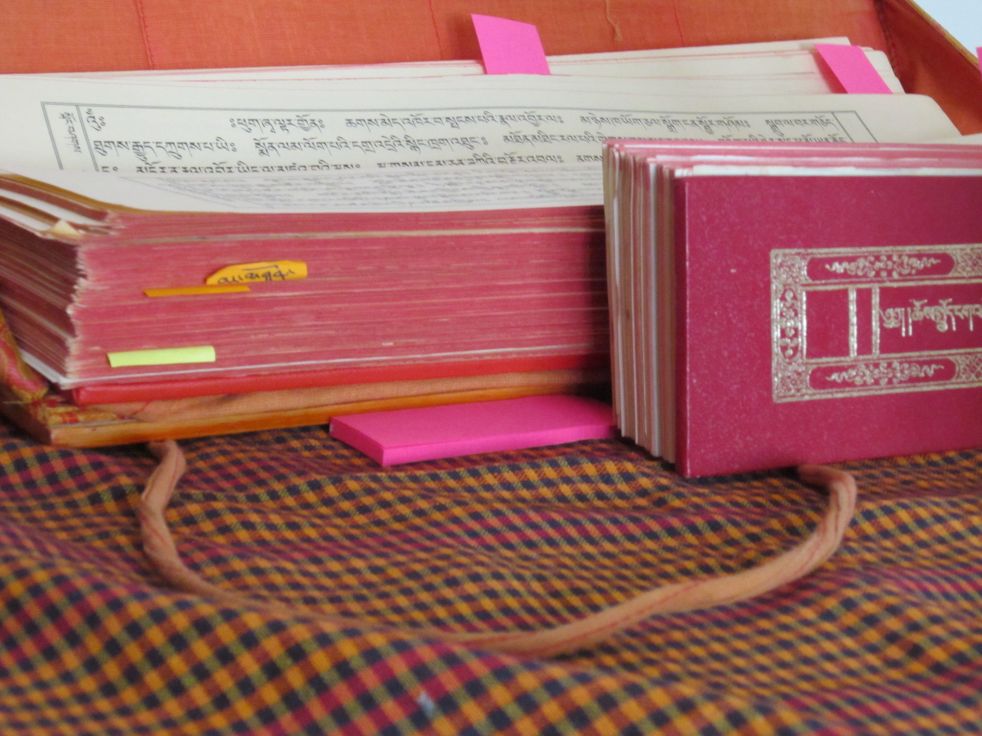
pechas

While posting photos is something I intend to continue with, I thought I had better write a little something.  Back in December I managed to get through yet another year’s final exams.  It was, as always, a huge challenge and probably my most productive time of year.  My subjects this year were:

  • Key to the Treasury by Dodrup Tenpai Nyima – a text about the Guyhagarbha tantra, according to the Zur tradition.  (mdzod lde)
  • The Precious Wish-fulfilling Treasury by Longchen Rabjam – a text about the foundations of practice, and in particular, the basis, path, and fruition of tantra. (yid bzhin mdzod)
  • Establishing Appearances as Divine by Rongzom Mahapandita – a text which brings logic together with the special view of tantra.  (snang ba lha sgrubs)
  • The Garland of Views by Padmasambhava – a text by Guru Rinpoche himself, detailing the nine vehicles, with a particular emphasis on tantra. (man ngag lta ‘phreng)
  • The Three Hundred Verses on the Vows of the Novice by Shakyaprabhawa – about our Vinaya vows, ie. the monastic code.  We studied part of this text last year. (‘dul ba sum brgya pa)
  • The Sutra which Embodies the Intentions of All the Buddhas – a tantric text covering a wide range of topics.  We study it in seventh, eighth and ninth year. (mdo dgongs ‘dus)

Occasionally someone will tell me how much they would like to study only the tantric section of our curriculum.  While I applaud any interest in studying these texts, I honestly cannot imagine being able to understand them without the background knowledge I gained in the first six years of shedra study. In fact, I’m not sure I can really claim to understand them now.

I think it might also be worth mentioning that these texts are focused on the theory of practice rather than instructions on how to practice. Here in shedra we focus on issues like:  How does the path work?  Why is tantra a swifter path?  What is the nature of reality?  What is meant by deity and divine?  We beleive that understanding these topics is crucial for developing the correct view, and without the view, there can be no path and no practice.

That isn’t to say that we don’t practice what we are studying.  Every monk and nun is practising, but practice takes many forms.  Meditation, of course, is the most well known form of practice and is indispensable.  Some praticioners however, may focus on reciting aspirational prayers,  making offerings and prostrations, etc.  Even careful observance of the monastic vows is a valid form of practice.  Likewise, I truly believe that when we study the Dharma deeply it is analogous to examining our own minds and can very directly act as an antidote to mistaken views and afflictive emotions.

February 2, 2012 / damchoe

Water and light

February 1, 2012 / damchoe

Little pieces of life…

Inspired by much better blogs than my own, I’m going to post some little snippets of my daily life in photo form.

January 28, 2012 / damchoe

Winter in South India

December 6, 2011 / damchoe

A nun studying for exams

November 12, 2011 / damchoe

Westerners in shedra – where are you guys?

Here is something that I’ve been thinking about lately:  There are no other international students studying in our shedra program.  (shedra, for those of you just tuning in, is what we call our college of Buddhist philosophy)  Usually, every year or so, I get a query about studying here at Namdroling.  Not this year.  Nonetheless, my blog stats tell me that one person found my blog by searching, “Can I get a student visa to study at Namdroling?”  Or something like that.  The answer is: Probably not.  I guess shouldn’t be surprised there aren’t any international students here if they can’t get visas.

Looking at the bigger picture: There are more and more programs opening up expressly for Western students.  I’ve audited a few classes at Rangjung Yeshe, in Nepal, and it is always the program I recommend the most.  IBD, in Dharamsala,  apparently has classes in English, as well as the option to join their regular program taught in Tibetan.  Also noteworthy are Rigpa Shedra and IBA, both located in Nepal.  So if you want to come to India or Nepal to study the Dharma in depth, and in English, there are options.  Usually it is possible to learn Tibetan while in these programs.

What I want to do in this post, though, is think about what skills an international student might need to join a program which is taught entirely in Tibetan.

  • Spoken language skills:  The better you know colloquial Tibetan, the easier things will go.  I myself hardly understood anything the teachers said when I was in my first year of shedra.
  • Classical language skills: More important than being able to speak Tibetan, you need to be able to parse the texts, use a dictionary, and be able to ‘get the jist’ of a text, at the very least.  Luckily a lot of our curriculum is available in English, so get ready to buy lots of books on Amazon.
  • Human skills:  Flexibility is crucial.  Although Tibetan Dharma centers in the West may feel very welcoming and accessible, monasteries in India and Nepal are quite different.  We actually share very little history with the Tibetans, and when we are on their turf, we need to play according to their rules.  Some people come to the monastery and try to change how it works, but they never last long.  We have to change ourselves and try to accommodate whatever circumstances arise.
  • Stick-to-it-ive-ness:  Most regular shedra programs are quite long.  Our nine year program is short compared to 18 or more years at the Gelukpa monasteries.  So you need to at least be open to the idea of staying for the long term.  Personally, I didn’t come to Namdroling with the thought of joining shedra, but got sort of ‘advised’ in to it by my teachers once I started getting the hang of Tibetan.  Now that I am nearing the end, people have a lot of nice things to say about my stick-to-it-ive-ness.  I tell them that I am sort of slow-minded, and it never occurred to me to leave.
  • Respect for the ordained:  Occasionally lay people are admitted to Tibetan shedras,  but most monastery programs only admit monks and nuns.  In either case, respect for the rules of the vinaya is crucial.
November 9, 2011 / damchoe

Detail of Gyaling (Tibetan oboe)

November 4, 2011 / damchoe

On blogs and books

I’ve been neglecting to blog to a few months. I imagine thirty or forty people actually read this thing on a regular basis, so if any of you have been hoping for a fresh post, here it is.

I wish I had more comments on my blog. I do. But when I read other blogs I almost never comment, so I don’t think the karma is there. I read a variety blogs that are outside of my area of expertise – for example, I read a few personal blogs written by LDS women, and one written by a Quidditch player in Montreal. I would feel strange commenting on them because, well, wouldn’t I be some weirdo? I mean, really, a Buddhist nun? How weird is that?

When it comes to Buddhist blogs… I almost never read them. I have several on my feed reader, but I just ignore them. What can I say? I spend most of my time reading Dharma texts in Tibetan and I enjoy it. But reading things such as a ‘Western perspective’ on Buddhism just isn’t as interesting.

Honestly, I hardly ever read English Dharma books anymore. Early on in my shedra career, translations of the texts we were study were so helpful. But now, unless it is translated by Padmakara, I usually take issue with the style of translation and decide I would be better off just reading the Tibetan.

Don’t get me wrong, though, I don’t only read Dharma in Tibetan. I also read fiction in English. I just started The Road by Cormac MacCarthy. I love e-books! I used to have to travel 2 hours by bus to find good fiction, but now I can just download something and put it on my e-book reader. And, of course, I’m always on the look out for new Harry Potter fan fiction. I like stories about Severus Snape.

August 4, 2011 / damchoe

Ten years in robes

It was ten years ago today that I took robes and shaved my head.  My relationship with ordination has changed and developed over the years.  Back then, I was 21 and just wanted to be ordained and learn Tibetan.  I thought I would stay at Namdroling for 2 or 3 years, then head back to Canada, maybe go to Gampo Abbey, and maybe do a bit of translating.  That was fine for the time, it put me in the right place to begin my monastic journey.

I worried a lot about support.  Who would take care of me?  Why don’t Western lay people respect and support monastics?  Why does it have to be so difficult?  Those feelings have diminished over time.  First of all, I have received a lot of support, from both my family and from friends I’ve met along the way.  Secondly, I am willing to support myself.  If if comes to it, I will work, or do whatever else needs to be done.

A few years into nunhood, I met a Western monk ordained in the Theravada tradtion.  He told me, “After about five years, it gets easier.”  That gave me some hope, and indeed, it got easier.

These days, when I sit in class, learning about the Guhyagarbha Tantra, I think – “I have to keep going with this”.  I need to learn this well, so that I can practice it correctly, and maybe, someday, pass it on.   This is a living lineage of scholar practitioners, and I hope very dearly that it can be well planted and take root in the West just as it has here in the East.  So I am trying to do my part, in my own small way, to be a vessel and a conduit for these teachings.

Today, I feel so much gratitude.  I feel gratitude to His Holiness Penor Rinpoche and to the Palyul lineage.  I feel gratitude for the teachings I have received and continue to receive, and gratitude just to have a quiet place to read the Dharma and meditate.  I am also grateful for this monastic community of which I am a part.  We are harmonious and we support each other spiritually – and that, indeed, is the whole point of the sangha community.

July 27, 2011 / damchoe

My adventures in birdy-sitting

Last Monday, my friend N.D. showed me a juvenile crow who had been injured by a dog.   I offered to keep it in my room.  N.D. said, “You can try keeping it for a day – and then give it back if you don’t want it.” I agreed and picked up the bird that evening.

I had a very hard time sleeping that night, as the perch and nest I had constructed for the bird were not very stable and he made some noise.  By the next morning I was torn on whether or not to give the crow back to N.D.  But, before I had the chance to let my wish for peace and quiet overwhelm my meagre compassion, N.D. told me someone had brought her another juvenile crow – thinking it was the first.  So now we both had crows and neither of us wanted to accommodate two.

So I decided to keep the bird for awhile, until he was ready to return to the wild. I named him Gonpo Severus Snape Tsering.  This was not the first time for me to give a pet a ridiculous name.  My geko in highschool was named Demothenese Theophany Chi (I had just finished reading Ender’s Game, hence the first name).

After a day or two, I learned to live with the bird, how to feed him rice and fruit, how to make his sleeping place dark so he would actually sleep, and how to wash my hands with Detol soap after every encounter.  Gonpo seemed to enjoy his time sitting on my window sill, pooping, and asking to be fed.

As the days went by he seemed to gain strength.  He evened out his damaged tail feathers, and eventually could fly from one end of my room to the other.  He still insisted on being fed by hand though, no matter how I tried to teach him to eat food that was placed in front of him.

Yesterday he figured out how to jump to the overhang of the window below mine.  I was able to retrieve him only when he made his way, sill by sill, to the ground three stories below. Although my intention was to release him eventually, I was hoping he would figure out how to find food for himself before then, so I brought him back up to my room.

Today he jumped out of my window and flew from sill to sill, until he reached the end of the building, and then launched himself into space.  I went down to ground level to look for him but there was no sign.

I have been expecting, everyday, that my relationship with this bird would end in a bittersweet manner, and so it has.  I hope that, somehow, he will find food, a safe place, and be able to escape the harms of dogs, cats, and others who would do him harm.

It was meaningful to care for Gonpo.  He wasn’t a cuddly sort of pet like a puppy, but I could tell he was benefiting from my help. Do I miss him?  Not so much as I just wish him well.  If he is found, and needs care, then of course I will care for him again. In the meantime I’ll just send him my prayers and love.

June 22, 2011 / damchoe

Funny Conversations 4

Roommate:  “When will the electricity come?”

Me: “It came at 5 pm yesterday.”

Roommate: “Really? Tell the truth.”

Me: “Really!”

Roommate: “Now lie to me.”

Me: “We have electricity right now.”

June 12, 2011 / damchoe

The Relevance of Buddhist Monasticism

My fellow Western monastics sometimes mention criticism from their lay fellows, much of which is to the point of, “Monastics are unnecessary in the West.” Or, “Western Buddhism is lay Buddhism.”

Now I could write about how the Sangha is four-fold, including monks, nuns, laymen, and laywomen, but you’ve probably already heard about that.  In essence, “Sangha” is a word we use to describe our Buddhist community, and whether or not your idea of “Sangha” includes four parts is up to you.

What I’m wondering is: Why make this sort of statement at all?  There may be some sense that monastics are more dedicated, more hardcore because they have given up the householder life.  But who can measure dedication?  We can only observe our own minds.  Only I know if I am developing or not .  I’ve been ordained for almost ten years now and I am certain there are thousands of lay practitioners who have more faith than me, who practice more than me, and who are generally nicer people.

It is hard to estimate the relevance of monastic practice as it relates to the lay community. For some, seeing the robes and peaceful demeanour of a monk might inspire them.  For others, it might just look silly.

That being said, I do find monasticism relevant in our modern world.  Why?  Because Buddha taught it as a practice.  To live in a dedicated community, to give up worldly concerns – that is a practice.  It is difficult, and for those who endure it, it can help them progress spiritually.  As a practice it is a deeply personal, internal process. As such I find it as relevant and useful as any other method Buddha taught.  A special aspect of Buddha’s teachings is that the practices are manifold; there are different practices for different types of mindset. Monasticism was never intended to be for everyone.

June 1, 2011 / damchoe

Balcony

May 29, 2011 / damchoe

Sun meets Rain

May 26, 2011 / damchoe

Overheard at the Nunnery #4

“She looks like that character in the Harry Potter movie… what was his name?  Oh yeah, Smeagol!”

May 23, 2011 / damchoe

Inside the classroom

A little while ago, Venerable R. D. asked me:

A bit of curiosity as to what shedra classes “look like.” Do you memorize the texts, study them, them go to class for commentary and teachings? Make notes in the text? Or is it anything like in the West with students trying to write down most everything the teachers says in lecture?

Let me paint you a word picture…  At eight-thirty in the morning, Monday to Friday, the bell rings and we go to class.  Our teacher enters the classroom first (our classroom is really small) and prostrates to the throne before sitting down.  Then we enter, prostrate to our teacher, and sit on cushions in front of him.

We start class by reciting a confession prayer and the Vajrasattva mantra, then a praise to Manjushri and his mantra.  Then our teacher recites some prayers to the lineage gurus and asks us to listen with the motivation of bodhichitta.

During class we take notes, either directly on our texts (in pencil of course) or in notebooks.  We don’t have any tables or desks, so note taking can be a bit tricky.  Some students like to record their classes on cassettes or mp3 recorders and listen to them again later.  We can also listen to recordings of the same subjects being taught by famous teachers such as Khenchen Pema Sherab and Khenchen Namdrol.

At the end of class we can ask questions and sometimes our teacher will also quiz us.

We conclude with dedication prayers and prayers for the swift rebirth of His Holiness Penor Rinpoche.

After class we have time to read and reread the text which was taught as well as relevant commentaries by other masters.  At five in the afternoon we debate on the morning’s lesson as well as anything else we have covered so far.  We keep studying in the evening, usually until 9:30 pm.

As for memorization, we can’t memorize the entire text, but we do memorize parts of it. We like to find quotes from the root text which epitomize the main points.

Follow

Get every new post delivered to your Inbox.

Join 557 other followers